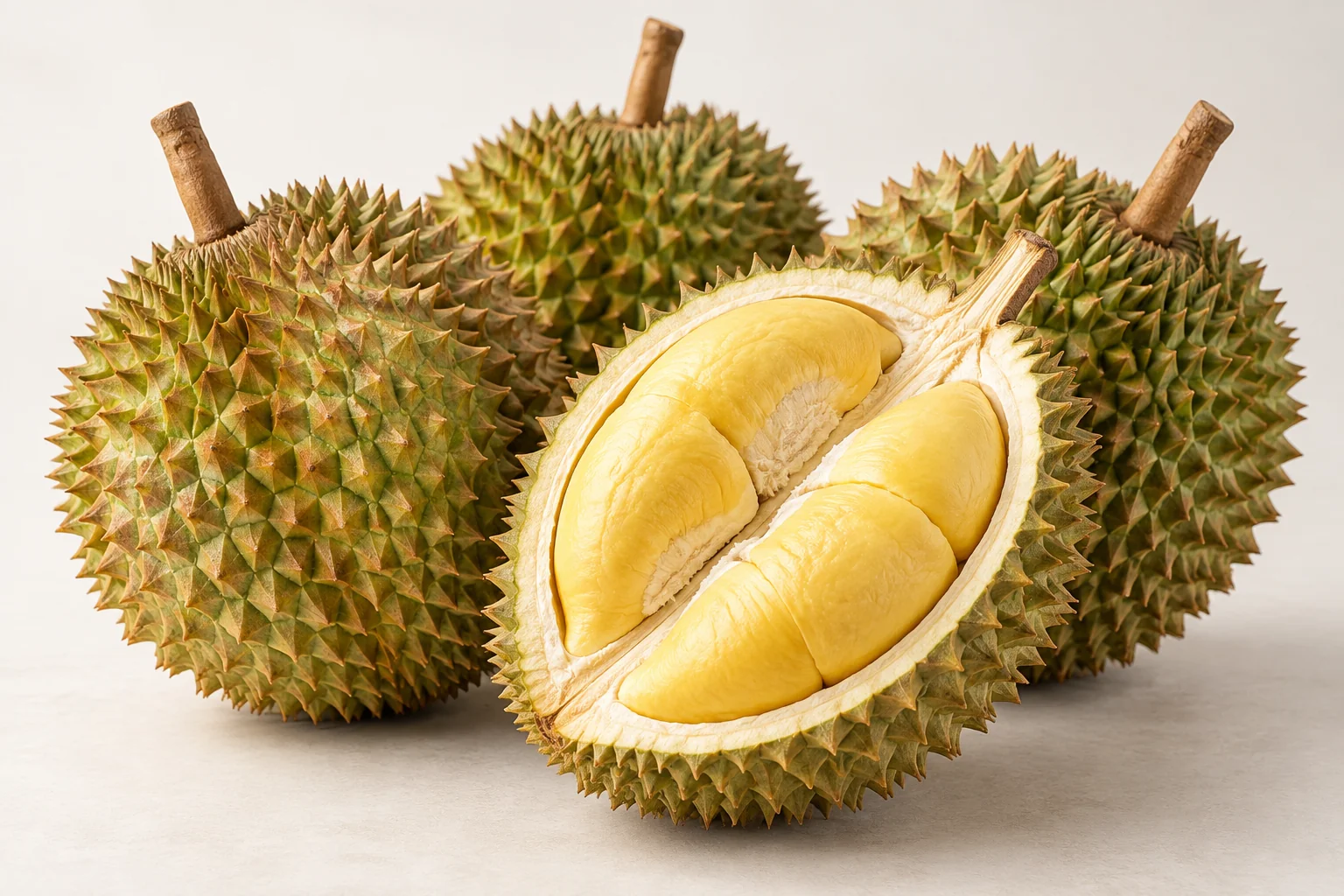
Fresh Thai Durian for Wholesale & Export
Buy whole fresh Thai durian from ThaiMahapoke, a supplier and exporter from Thailand serving importers, distributors, wholesalers and retail buyers.
Monthong is our main variety. We also sell Chanee and Kanyao, with availability checked against the season, required quantity and shipment window. Our minimum order is one 40-foot refrigerated container.
Tell us your preferred variety, fruit size, destination and delivery window for a wholesale quotation. Product specifications, packing and shipment terms are agreed before order confirmation.
Fresh Thai Durian at a Glance
- Origin: Thailand.
- Product form: Whole fresh durian.
- Main variety: Monthong; Chanee and Kanyao are also sold, subject to current supply.
- Minimum order: One 40-foot refrigerated container.
- Brand: ThaiMahapoke.
- Buying specifications: Agree fruit size, harvest maturity, arrival condition, quality criteria and packing for the order.
Thai Durian Varieties Available for Inquiry
Choose the cultivar your customers require before comparing quotations. A cultivar name identifies the variety; it does not define a quality grade, fruit size or guaranteed eating condition.
| Variety | Commercial availability | What to specify |
|---|---|---|
| Monthong / Mon Thong | Our main variety; supply is checked for the requested shipment window. | Required fruit-weight band, maturity, arrival condition and quantity. |
| Chanee / Chani | Sold subject to seasonal and lot availability. | Named cultivar, target customers, size and receiving requirements. |
| Kanyao / Kan Yao | Sold subject to seasonal and lot availability. | Named cultivar, size, presentation criteria and shipment window. |
If you accept an alternative variety, identify it in the inquiry. Any substitution must be agreed before order confirmation.
Choosing Durian for Your Market
Start with your sales channel and receiving requirements. A wholesale distribution program and a retail program may require different size consistency, presentation and time available for onward sale.
| Buying decision | Why it matters | What to tell us |
|---|---|---|
| Cultivar | Your customers may require a named variety. | Monthong, Chanee or Kanyao; acceptable alternatives, if any. |
| Fruit size | Affects price per fruit, packing and resale bands. | Preferred weight range and acceptable variation. |
| Maturity and arrival condition | Must fit the journey and the time before sale. | Required receiving condition, arrival date and onward distribution time. |
| Quality criteria | Determines how fruit is accepted or rejected. | Acceptable external marks, damage limits and any internal-quality sampling requirements. |
| Packing | Must protect the fruit and suit receiving operations. | Carton requirements, net weight, labels and pallet needs. |
| Destination | Determines the import checks and transport options to assess. | Country, port or receiving point and required documents. |
What Is Fresh Thai Durian?
Fresh Thai durian is the whole fresh fruit of Durio zibethinus grown in Thailand. The fruit has a spiked husk and edible flesh surrounding its seeds.
This page covers whole fresh durian for commercial distribution. Monthong, Chanee and Kanyao are cultivar names. Frozen whole durian, frozen flesh, pulp, dried durian and freeze-dried durian are different product forms and are outside this fresh-fruit offer.
Product Information & Specifications
| Attribute | Product information / buying specification |
|---|---|
| Product | Fresh Thai Durian |
| Botanical identity | Durio zibethinus |
| Country of origin | Thailand |
| Form | Whole fresh fruit |
| Varieties | Monthong as the main variety; Chanee and Kanyao also sold, subject to current supply |
| Brand | ThaiMahapoke |
| Minimum order | One 40-foot refrigerated container |
| Fruit size / weight | Agreed weight band and tolerance for the available lot |
| Harvest maturity | Agreed cultivar-specific assessment criteria suitable for the shipment and applicable requirements |
| Arrival condition | Receiving condition agreed with reference to transit and onward distribution |
| Quality / grade | Agreed quality criteria; any requested grade must have a defined standard and acceptance basis |
| Defect tolerance | Agreed limits for external damage, decay, splitting and other relevant defects |
| Carton configuration | Net weight, fruit count, dimensions and markings agreed before order confirmation |
| Inspection / testing | Scope, sampling, timing and documentation agreed for the order |
| Shipping and delivery | Destination, route, shipment window and commercial terms agreed in the quotation |
A 40-foot container is the minimum order unit, not a fixed promise of tonnes, fruit count or carton count. The load plan depends on the agreed fruit sizes and packing configuration.
Export Packaging for Whole Fresh Durian
Whole durian needs packaging that accounts for its weight, spiked husk and handling conditions. The carton arrangement should limit pressure and rubbing damage while allowing the ventilation required by the transport plan.
Before order confirmation, agree:
- Carton format, dimensions and net fruit weight.
- Fruit count or size mix per carton, where required.
- Carton strength, internal protection and ventilation.
- Pallet requirements and handling restrictions.
- Lot identification, required labels and carton markings.
There is no single carton specification for every order. Final packing details are agreed for the selected lot and shipment program.
Minimum Order & Commercial Terms
Minimum order: One 40-foot refrigerated container or more.
Quotation basis: Specify the cultivar, quantity, size band, maturity, packing, destination and shipment window. Price and delivery timing are quoted against the actual requirement and available supply.
Delivery terms: State your preferred Incoterm and named delivery point. Applicable FCA, FOB, CFR or CIF terms are agreed for the order. A quotation should identify the place or port and the costs included.
Supply timing: Availability varies by cultivar, season and required volume. Shipment dates and preparation time are agreed before order confirmation; inquiries are not a guarantee of immediate stock.
Payment terms for new buyers — sea shipments
For sea orders agreed under our B/L-based payment and cargo-release arrangement:
- 50% deposit by T/T upon order confirmation.
- The remaining 50% is payable by T/T after the buyer receives a copy of the Bill of Lading and the agreed export documents.
- The buyer may request a video call or live product review before paying the remaining balance, subject to arrangements for the order.
- Original Bills of Lading, telex release authorization or other cargo-control documents will not be released until full payment has been received and cleared.
- Alternative payment terms may be considered case by case for repeat buyers with an established transaction history.
A payment slip alone does not confirm cleared funds. A video review supports buyer visibility and does not replace physical inspection, independent inspection or laboratory testing. Payment and cargo-release arrangements must be confirmed for the actual shipment method.
Fresh Durian for Wholesale & Retail Distribution
Importers and distributors: Source named Thai cultivars for fresh-fruit distribution. Agree the receiving condition and allow for the time needed to move fruit through the downstream network.
Wholesalers: Specify usable fruit-size bands, quality tolerances and carton requirements for handling and resale.
Retail chains and supermarkets: Align cultivar, appearance, fruit size, labeling and expected selling period with the retail program.
Selected food-service buyers: Whole fresh fruit may suit operations that can handle and open durian on site. Buyers requiring ready-to-use pulp or frozen portions need a different product form.
Quality Review & Inspection Requirements
Define acceptance criteria before shipment so the product can be reviewed against the same requirements used in the quotation.
Relevant checks can include:
- Cultivar identification and lot information.
- Harvest maturity, including dry-matter assessment where required by the applicable standard or agreed inspection plan.
- Fruit size consistency and agreed tolerances.
- External condition, stem condition, splitting, physical damage, pests and decay.
- Internal condition under an agreed sampling plan, where requested.
- Carton condition, net weight, labels and shipment records.
If you require independent inspection or laboratory testing, state the scope, sampling basis, timing, report format and destination requirements in the inquiry. The applicable arrangements and costs must be agreed before order confirmation.
Inspection reports describe the inspected samples and scope; they should not be treated as a guarantee of every internal characteristic of every unopened fruit.
ThaiMahapoke Branding & Shipment Labels
Fresh durian is currently offered under the ThaiMahapoke brand. Buyer-branded cartons and private-label programs are not part of our current offer.
Carton artwork, label layout and lot markings are agreed as part of the packing specification. Required origin, packing-house, traceability and destination information remains on labels and documents where applicable. Branding does not replace mandatory shipment information.
Your Fresh Thai Durian Supplier & Exporter
ThaiMahapoke is a B2B seller, supplier and exporter from Thailand. We work with growers, farmer groups and farms in Thailand to source fresh durian according to buyer specifications and sourcing requirements.
Our offer gives buyers a clear starting point: Monthong as the main variety, Chanee and Kanyao subject to supply, and a minimum order of one 40-foot reefer. The quotation sets out the agreed product, packing and commercial terms so buyers can assess the shipment on a defined basis.
FAQ for Importers & Wholesale Buyers
Which Thai durian varieties do you sell?
ThaiMahapoke sells Monthong as its main variety, as well as Chanee and Kanyao. Availability is checked against the season, required quantity and shipment window. State your preferred cultivar and any acceptable alternatives when requesting a quotation.
Is this whole fresh durian or frozen durian?
This offer is for whole fresh durian grown in Thailand. Frozen fruit, peeled flesh, pulp, dried durian and freeze-dried durian are outside this fresh-fruit offer and require separate product assessment.
What is the minimum order quantity?
The minimum order is one 40-foot refrigerated container. The net fruit weight and number of cartons are determined by the agreed fruit sizes, packing and load plan; they are not fixed by the container size alone.
Can I order a specific fruit size or grade?
You can state a preferred fruit-weight band, quality standard and defect tolerances. ThaiMahapoke will assess the request against the available lot. A grade label needs defined criteria and should not be used as a substitute for an agreed buying specification.
How should I specify maturity and ripeness?
Specify the cultivar, destination, required arrival date and intended selling period, together with any maturity or receiving criteria you use. Harvest maturity concerns whether the fruit is sufficiently developed; eating ripeness concerns its condition for consumption. The shipment specification should address both where relevant.
What carton sizes and packing weights are available?
Carton dimensions, net weight, fruit count, protection, ventilation and markings are agreed for the selected lot and shipment program. Send your packing requirements with the inquiry. ThaiMahapoke does not publish one fixed carton configuration for every order.
Can you supply durian in my own brand?
Buyer-branded cartons and private-label programs are not currently offered. Fresh durian is offered under the ThaiMahapoke brand, with packing details and required labels agreed before order confirmation.
Is fresh durian available throughout the year?
You may submit an inquiry for your required shipment period. Actual availability varies by cultivar, season, volume and source lot. ThaiMahapoke confirms the available options and shipment timing for each order rather than guaranteeing year-round stock of every variety.
Do you guarantee a fixed shelf life or storage temperature?
No single shelf life or temperature setting applies to every fresh durian shipment. Cultivar, maturity, condition, packing, transit and receiving arrangements must be considered together. Agree the handling plan and arrival requirements for the actual order.
Can I request inspection before shipment?
Yes, you can include an inspection request in your inquiry. Specify the checks, sampling basis, inspection timing and report requirements. Availability, responsibility and cost must be agreed before order confirmation; independent inspection and laboratory testing require their own arrangements.
What are the payment terms for a first sea order?
For new-buyer sea orders agreed under ThaiMahapoke's B/L-based arrangement, payment is 50% by T/T upon order confirmation and 50% by T/T after receipt of the B/L copy and agreed export documents. Cargo-control documents or release authorization are withheld until full payment has been received and cleared. A video review may be requested subject to the order arrangements.
What do you need to quote, and can you supply my country?
Send the cultivar, quantity of at least one 40-foot reefer, size and maturity requirements, packing, destination country and port, shipment window and requested delivery term. Include required inspections and documents. Market access and shipment requirements must be checked for the destination before an order is accepted.
Request a Fresh Thai Durian Quotation
Planning a shipment of at least one 40-foot reefer? Send your requirements to ThaiMahapoke for a supply check and wholesale quotation.
- Company name, contact person and contact details.
- Preferred variety: Monthong, Chanee or Kanyao.
- Acceptable alternative varieties, if any.
- Quantity or number of 40-foot refrigerated containers.
- Destination country, port and receiving point.
- Target shipment window and required arrival date.
- Preferred fruit-weight band and quality or grade criteria.
- Harvest maturity and required arrival condition, if specified.
- Carton, net-weight, labeling and pallet requirements.
- Preferred Incoterm and named delivery point.
- Inspection, sampling, test reports and import-document requirements.
- Intended sales channel and expected onward distribution period, where useful.
If you do not yet have a detailed maturity or packing specification, provide your destination, sales channel and target receiving date so the requirements can be reviewed.
Compare Fresh Durian Offers on the Same Basis
Before comparing prices, check that each offer covers the same cultivar, fruit-size range, maturity, quality tolerances and carton net weight. Also compare the named delivery point, freight inclusion, inspection scope, documents and shipment window.
A lower price is not directly comparable if the fruit specification or delivery responsibilities differ. Keep the agreed specification and acceptance criteria with the order documents.
Harvest Maturity & Arrival Condition
For fresh durian, sufficiently mature fruit and fruit ready to eat are not the same specification. Harvest selection must fit the cultivar and applicable requirements, while the intended receiving condition must fit transit time and the buyer's distribution plan.
State whether the fruit will move through wholesale distribution, go to retail shelves or be used shortly after arrival. Include the expected time between receiving and sale. Where maturity testing is required, agree the method, sampling and acceptance criteria rather than relying on an undefined ripeness percentage.
Transport & Cold-Chain Planning
The minimum order for this offer is one 40-foot reefer. Plan the shipment around the selected cultivar, maturity, packing, destination, transit duration and receiving arrangements.
Temperature management, ventilation and handling should be agreed for the actual program. Excessive cooling can damage fresh durian, so a lower temperature should not automatically be treated as better protection. Plan unloading and onward distribution as part of the journey.
This container offer does not automatically include a small air-freight option. If your procurement plan requires another shipment method, request a separate commercial assessment; availability and payment terms must be confirmed for that method.
Destination Requirements & Export Documents
Provide the destination country and receiving port before quotation. Import eligibility, plant-health requirements, relevant registrations, labeling and document needs must be reviewed for the actual destination and shipment.
Depending on the applicable requirements, the shipment may need:
- A commercial invoice and packing list.
- Transport documents appropriate to the shipment method.
- A phytosanitary certificate and any required additional declarations.
- Origin documentation where applicable.
- Relevant orchard, packing-house and lot-traceability information.
- Required inspection or laboratory reports.
- Destination-specific carton markings and labels.
Confirm which requirements the importer must arrange and which documents are included in the seller's scope before accepting the order. Supply from Thailand does not by itself establish permission to import into every country.